Friday, July 11, 2008

#15 Revolving Door at the Library

Longitude by Dava Sobel. I'm probably the last person on earth to read this book, but it was fascinating. The slim volume follows the intrigue--really!--involved with the race to solve measuring longitude at sea to win the huge prize offered by the British government. Easy to follow and a good read. A whole lot easier and more interesting than Galileo's Daughter, which I am forcing myself to read. It's like taking cough medicine. Without codiene. Except for the part where I keep falling asleep.

Non-fiction: 13.5

Thursday, July 03, 2008

#15 Yet More Non-fiction

Language Visible by David Sacks tells the story of how our letters came to be. The story of many of them is similar. Start with the Phoenicians, move to the Greeks, an ill-understood stop with the Etruscans, (or is that the other way around?) then the Romans, then Anglo-Saxons with some input from the French. The books is interesting and accessible (reviewers call it "lively" and "engaging") but there is quite a bit of overlap because of the way he chose to tell it--one letter at a time. Because letters are related in development or sound or use there's even more overlap. I think I remember reading that this was based on a column he wrote in a newspaper, and if so, that would explain some of it. The other problem is there are a lot of "sidebars" in the book. They are interesting and I'm glad I read them but they totally interrupted the flow of this fascinating look at letters.

I will be forever grateful for the reminder of the yogh. Along with thorn, yogh (I can reproduce neither symbol) was a letter I learned while studying Middle English (an undergraduate graduation requirement) but for the longest time I could only remember thorn. It drove me nuts. Now I know.

Non-fiction: 12.5

Wednesday, June 25, 2008

#14 Done

I was going to write about the Amanda Pepper/Philadelphia mysteries that Nancy Pearl turned me on to. I finished Philadelphia Stakes the other day. But then I started adding up the number of novels I had read. I was on eight before I started rereading the Potter series, which would have brought me to 15 but somehow the numbers got out of whack. I listed the Friday Night Knitting Club as 14 and both Ella Minnow Pea and Gaudy Night as 15. They were 16, 17, and 18 respectively. So now I am on 19 and even the Harry Potter naysayers have to allow that I have more than met my goal.

Tuesday, June 24, 2008

# 38 Frame Up

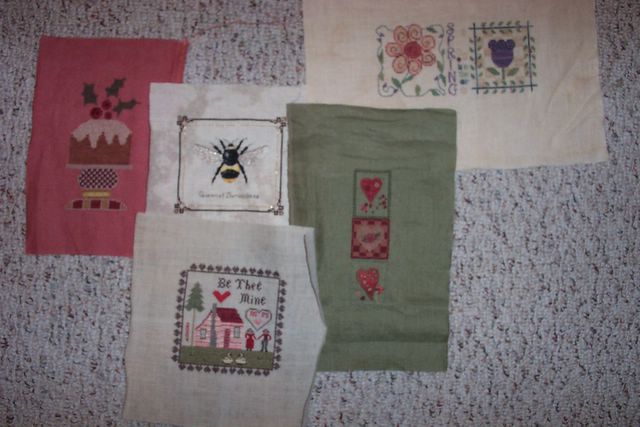
Here they are:


Trio of Hearts
Twisted Threads
Completed June 2004


You Are My Sunshine
La D Da
Completed June 30, 2006
Gift to the dude for our 5th anniversary


My Whole Heart
SamSarah Designs
Completed July 7, 2007
anniversary gift, 6th anniversary

In the Tall Flowers
Liberty Street Designs

Six more to go! I'll be bringing the dude's anniversary present in on Saturday, and I think I may take a few more pieces in.

Sunday, June 22, 2008

Reading

Things at work are heading south fast. I met on Monday with the evil AVP (former boss's boss) to get a list of my new responsibilities and to find out that they're not even going to start the hiring process until after Labor Day, which means I've gone from being a team of three to a team of one (my junior colleague transfered to another part of the group). My good boss and I went over the list together, and she helped me come up with a figure for my new salary. So on Wednesday when the AVP sent me an e-mail listing those responsibilities, I wrote back thanking her and asking for a meeting to discuss salary. She wrote back basically telling me no; she's taken away some of my responsibilities in addition to giving me the new ones and that everyone's salaries will be reviewed once the consultant finishes their analysis of the group. (Those responsibilities that she took away account for about 4 hours a month. The ones she gave account for about 20 hours a week.) On Thursday I wrote back responding to her "argument" and again requesting a meeting. Nothing.

So when I saw The No Assholes Rule: Building a Civilized Workplace and Surviving One That Isn't at the library yesterday, I had to check it out. Written by Stanford professor of management, Robert Sutton (PhD), the book defines "asshole" and explains the difference between the temporary and the certified asshole, explains the rule and how to implement and enforce it, knowing when you are the asshole and how to stop being one, and how to survive on "Asshole Avenue"--which is where I work.

It takes two things to be an asshole: 1) people who encounter the asshole almost always feel worse about themselves afterwards and 2) assholes focus their venom on the powerless. So, like the AVP who has actually stuck her tongue out at my junior colleague in meetings with people from different parts of the organization and saying repeatedly, "I know where you're going." Which isn't horrible in and of itself, but it is part of a larger pattern of behavior which includes far too many things to include here. Suffice to say she prides herself on micromanaging and demanding things and using the most condescending tone imaginable. She's a kiss-up, kick down kind of person who sides with everyone but her group. Oh, she's an asshole.

So anyway, the advice for dealing with the assholes is to run*. Which I had sort of figured out on my own. It took me a while to realize the AVP is part of a larger problem that starts at the top and wends its way through the entire organization, not just the group, not just our department. (As Sutton says, "Assholes breed like rabbits" because they hire their own kind.) So in the near future, there might be less money available to do some of the things on this list--though I will have more time to do them...

She's leaving for vacation on Thursday. Would it make me an asshole to hand in my letter of resignation on Wednesday?

*If you can't, you're supposed to float downstream with your legs out in front of you. Which I don't get.

Non-fiction: 11.5

Tuesday, June 17, 2008

#15 On a Roll

This is the book I took a hike to get. I've enjoyed reading Adrienne's blog and I have a keen interest in maternal ambivalence based on my dissertation. I picked it up on Thursday (6/5), and finished the next day, but it's taken me a while to write this all down.

I wish I had known Adrienne when she was pregnant. Not that I could have "saved" her, but I could have given her a big pile of books to read to let her know she's not alone. (Rozsika Parker's Mother Love/Mother Hate for one.) Because she had all that time for reading when she was in the bin.

Adrienne's book is smart and funny and incredibly self-aware about a time when it must have been hard to be smart or funny. My favorite line, on the birth of her daughter, "It’s like getting the best Christmas gift ever, but Santa decided to kick the crap out of you before you unwrapped it." I particularly liked her analysis of Marjorie Kempe but wish she had found a few more such examples in her history of ppd/pp psychosis. Her portraits of the places she's lived bring them to life, making them another character in the book. And that's not far wrong because, according to Adrienne, there is something about place that has contributed to the madness in her family line.

My work on this subject takes a different tack. Mothers who are violent or ambivalent are usually labeled mad or bad. And I looked at what was behind the impetus to label the problem an individual one. My argument was that if we made it the woman's problem then it wasn't society's problem, that is it's nothing to do with me if a woman can't handle being a mother. There is an incredible pressure put on women to be "perfect" mothers--despite what some reviewers think. (One suggested that Adrienne just put too much pressure on herself to be perfect, that that didn't really exist.) But that same society refuses to create the safety nets (state sponsored day care, anyone?) that would allow women to achieve this.

It's a good book about a horrible time in one woman's life (though she stands in for many more). It's not for everyone, certainly.

Non-fiction 10.5

Monday, June 16, 2008

#15 Sticking with it

I have finished another work of non-fiction: Kentucky Moonshine by David W. Maurer. My dad sent this to us because there were a few things he wanted explained. Fortunately, I didn't have to read the book to figure it out.

I do have to tell you that this may be the second worst book I've ever read. Originally published in the 70s this is an incredibly dull work of academic well, it's supposed to be history but there is an utter lack of evidence. I suppose it is an early attempt at cultural studies but of the worst kind. The book is repetitive, lacks logical structure, and isn't well documented. But other than that...

Here's a favorite passage which gives you the flavor:
Transporters are paid from $1.00 to $2.00 per gallon according to the area, the risks involved, and other factors. Usually the owner of the still makes arrangements for the transportation and pays the driver, the cost being passed on to the purchaser. In some areas, the bootlegger hires and pay the transporter himself. These drivers spend as little time as possible around the still and do not openly associate with moonshiners. They are almost always unmarried but often temporarily live with one of the less conventional girls in their own or a neighboring community. Their prowess with women is well known and their tastes run to the flashier type of girl. Since they are paid by the gallon, any risks they take are usually their own, and they may do time if caught. A considerable number are killed or maimed in high-speed chases and most of them at one time or another have been involved in a serious accident. When they no longer drive the hot transport cars, they tend to degenerate into a kind of soft and slovenly indolence, existing as best they can on the empty memories of their younger days.

Ah, scholarship, you've come a long way.

My other favorite line comes from the section where he speculates about the decline of moonshine drinking among young men: "In addition, teenage girls play more and more of a part in the recreational pattern of young men...Because of the cultural factors and the liquor's taste, few girls drink moonshine whiskey with pleasure. However, beer is usually available even in dry territory and this lighter drink may be shared by boys and girls, resulting in a general upgrading of interpersonal relations."

Euphemism anyone? The first three chapters are given over to describing making moonshine in your pressure cooker, building a still, and running the still. The three longest chapters of my reading life. There is also a long prologue to the glossary that describes the reasons why moonshiners might develop their own argot. On the whole, a tedious treatment of a possibly interesting subject.

Non-fiction: 9.5

Thursday, June 12, 2008

#15 Still More Non-fiction

Stuffed: Adventures of a Restaurant Family is the memoir of Patricia Volk whose family owned Morgens in NYC. I suppose it's a happy family because in a lot of ways it was like mine (If all unhappy families are unhappy in their own ways, we must be happy ones, right?) except Volk's family made the papers in New York City more often than mine did in small town New Hampshire. Her family members: introduced pastrami to America, invented the multicolored retractable pen, won best legs in Atlantic City, and one was held hostage for seven hours by a burgular. I'm not going to hold my family up to such scrutiny.

Each chapteris named for a food Volk associates with the person or people featured int he chapter. So Uncle Bob is profiled in "Mallomars" (my uncle Bob would be in the "weed" chapter) and her sister is in "Scrambled Eggs" (my sister might be Circus Peanuts). Each family member's story--which is told with a great deal of kindness--has a moral tale, which, according to Telling True Stories, is desirable. Several people stand out in my mind. Aunt Lil has two embroidered pillows on her couch: "Hope for the best. Expect the worst." and "I've never forgotten a rotten thing that anyone's ever done to me." Wow. (There's more needlework too: her family's housekeeper is a quilter.) Aunt Ruthie (who survived being held hostage) is the master of the biting zinger, one of those offhanded little remarks that can cut to the quick. I had planned to read it at Sunday dinner because it's my grandmother all over. But last night I read it to my sister, and she wants to borrow the book. When I read a little bit of the criticism the mother makes, she wanted me to send the book to our mother. I have a feeling this, like Marley and Me, is going to be a book that makes the rounds in my family.

I skipped another book I've read because I want to think about it more before I write about it.

Non-fiction: 8.5

Saturday, June 07, 2008

#15 More Non-fiction

Telling True Stories: A Nonfiction Writers Guide
This is a compilation of five years of presentations from the Nieman Conference on Narrative Journalism. I read it for work, but I think there were lessons even for blog writers. Blog writing is a form of memoir, which is, after all, narrative journalism. Somewhere I wrote this long essay about blogs-as-memoir and the difference between memoir and reportage (and thus between a truth and the truth, or, you know, as close as we can get).

For me this book was useful because there are a lot of things that I know about writing, but not so many that I know about reporting. Well, I know them but I don't always have ways of articulating them. And I certainly think that skill will come in handy when I am interviewing for jobs.

non-fiction: 7.5

Tuesday, May 27, 2008

#72 Go on a Picnic

I think I was thinking of something a bit more romantic than having lunch al fresco at Haverford College, but all I wrote was "go on a picnic." So I have fulfilled that. Yesterday, the dude, his mother, and I ate egg salad, mozzarella and tomato salad, and roasted vegetables under the "Penn Teaty Elm." Allegedly, William Penn signed the Shackamaxon treaty in 1683 with the Lanape Indians under an elm. That elm died in a storm in 1810, but someone took a graft. That elm died from Dutch elm disease in 1977. However, self-seeded offspring from 1915 survive. And that's the one we ate under.* So, it's like the grandson. It's freakin huge.

Penn Treaty is in quotes because it is both the cultivar of the tree and gets the marks, but also beyond a painting, no record of the treaty remains. So, like, Penn was never probably under that elm tree and people went to a lot of trouble to maintain it.

* This tree is friggin' spectacular and this is the photo you choose?

Sunday, May 25, 2008

#38 Frame 10 FUFOs

Yesterday, I dropped off four pieces at the Strawberry Sampler. They are having a sale 20% off all framing--including the mounting, which they usually exclude from sales. The pieces are My Whole Heart Loves You, You are My Sunshine, Trio of Hearts, and Tall Flowers. Photos when I pick them up in about a month.

Thursday, May 22, 2008

#15 Read 16 Works of Non-fiction

This book is a record of the traveling I would like to do. I would like to go somewhere and get into the culture. I suppose I did that to an extent when I taught English in Poland, but there was something extra safe about being able to call on friends and colleagues when my complete lack of Polish got in the way of me ordering food, about spending time in large groups at tourist destinations, about being carried into the emergency room but surrounded by people who spoke my language.

Erika Warmbrunn decided to run away with her bicycle to Russia and rode all the way to Vietnam. In time she learned to walk into Mongolian gers when she sought shelter, how to offer food to people in China, and how to properly address people in Vietnam. Erika's writing is very good, and she's able to express the human warmth that is generated by a bowl of soup, or sharing a bed, or washing one's feet in (finally) hot water. She is generous about all of the people she meets which makes the reader like her all the more.

I don't remember Erika specifically, though we seem to have been in Russian class together at Bryn Mawr. Her facility with languages and my utter lack thereof may be part of the reason; she was probably one of those people who just wished I would study more (I did!) or drop the class (what and work hard to become mediocre in yet another required language?) .

Erika claims that there is nothing she did that we all couldn't do. But I think there is. The dude, for example, really isn't much of a bike rider (he's ridden twice in nearly 40 years). With my crazy gut illness and falling down issues and chopping myself to pieces problem, I really couldn't have spent that much time in a country that still uses 1950s-style medicine. (I know this about Mongolia because I interviewed a doctor who does heart surgeries there.) Also, there's the complete lack of language facility--though I can say ferroviaria like a native Italian. Unfortunately, I can ask for the train station or a stamp in Rome but not understand the directions I get in return. And in the 15 or so years since she went and did this crazy thing there have been more white people traveling to the far corners of the earth. But she's also right; each of us can put one foot in front of the other and complete a journey of 5000 miles. We only need open our hearts.

Non-fiction: 6.5

This is my 100th posts and I wish that meant I was closer to finishing 101 things than I am. Sigh.

Wednesday, May 21, 2008

#15 Read 16 Works of Non-fiction

In Other Words: A Language Lover's Guide to the Most Intriguing Words Around the World by Christopher Moore translates some of the foreign words and idiomatic expressions that are reckoned to be "untranslatable."


Words I wish I could remember so that I could use them more:
  • esprit de l'escalier (French) witty remark or smart retort that you think of too late to say (in fact, on the stairs)
  • korinthenkacker (German) raisin pooper--someone taken up with life's trivial detail that they "crap raisins." (bureaucrat?) Interestingly in Dutch, a raisin pooper is someone who's cheap.

  • egyszer wolt budan kutyavasar (Hungarian) "There was a dog market in Buda only once" that is an opportunity you must take or you will regret it.
  • Nie dla wszystkich ckrzypce graja (Polish) the violin doesn't play for everybody. If you've ever heard someone try to learn violin, you should understand the essence of the idiom.
  • hankikanto (Finnish) in the book they say it resists translation into many languages because it is "a frozen crust on the surface of snow that is strong enough to walk on." I recognized it instantly, though I imagine some people who didn't grow up far enough north wouldn't.
  • denize girse kurutur (Turkish) "he gets dry if he enters the sea" someone who can't do anything right.
  • aware (Japanese) awareness and appreciation of the ephemeral beauty of the world. Part of the idiom mono-no-aware "enjoying the sadness of life." Moore writes "it's that bittersweet, vaguely poetic feeling you get ...looking out at the driving rain." Isn't it interesting that I felt this on Sunday but didn't have a word for it until Monday?
It's interesting to learn the sorts of philospohies that don't exist in other languages like compromise--or the nuances of relationships that do exist in other cultures. Just like me to read a dictionary. Wordork.


Non-ficion: 5.5

Monday, May 19, 2008

# 14 Read 16 Works of Fiction

When I was dying of boredom, I got the dude to take me to the library, and this is one of the books I got. There's something I love about Peter Whimsy. Gaudy Night is one of my favorite mysteries of all time. Unnatural Death is more of a how-dunnit than a who-dunnit--kind of like Columbo. There is something a little jarring, though, about the 1920's lack of political correctness, or as the new book I am reading, In Other Words, would have it, onderbuikgevoelens (Dutch for socially unacceptable sentiments). Full report when I finish, probably on the bus ride home.

Recently--Mother's Day to be exact--I gave my niece a box of our old books. My contribution was the Nancy Drew novels I had loved as a child and my sister's was some Roald Dahl novels. Yesterday, Lala reported that she's read three Nancy Drew books. They're saying she takes after me. Of course, the books are short and she has way more free time than most of us, but she is only eight.

Fiction: 15

Tuesday, May 13, 2008

#14 Read 16 Works of Fiction

Ella Minnow Pea
by Mark Dunn

Another in the series of books recommended by Nancy Pearl, Ella Minnow Pea is a "progressively lipogrammatic epistolary fable." On a fictional island nation off the coast of South Carolina, a government grows steadily more oppressive (linguistically at first) as letters fall from a statue dedicated to the developer of the pangram "The quick brown fox jumps over the lazy dog." The situation grows increasingly absurd until half the island is in exile. In the past few years I have found reading books about oppressive governments to cause me to feel increasing dis-ease. Especially when so many characters are willing to stand by and let the government do as it pleases. Interestingly, the Kirkus review calls this book "lighthearted" where LJ (in a starred review) compares it to "The Lottery" or "Fahrenheit 451" with "farce and comic relief" stirred in. I have to say I'm on the side of Library Journal. Other reviewers say it's a book for people who love words and wordplay, and I'll admit to you I needed to use the dictionary once while I was reading. It's surprising how obscure words come to the fore when you can't/don't write with the letters q, z, j, and d.
Fiction: 15

Tuesday, April 29, 2008

#39 Send Four Items to be Professionally Finished

Two down. I can highly recommend Mona, finisher for The Silver Needle.


Monday, April 28, 2008

#33 No TV

Well, we've done it! This morning I turned on the television to check the weather but only left it on for about 5 minutes. And thus ends an experiment. The only time I missed watching was when I realized this weekend was the NFL draft. I can't believe these two events coincided. I have watched the draft--both days--for years. One year I even recorded all the data, but that was when I had a former student who was drafted by the Atlanta Falcons.

We just fired up the magic box and reviewed the lists of draftees. It wasn't as good as watching but I got the information just the same. I think we may have relied on the computer too much as a substitute for the television, though. I drew the line and didn't watch any television on the computer. Maybe next time we'll have to ban the computer too. In the evenings anyway.

Tuesday, April 22, 2008

#33 Go without tv for one week--in season

It's National Turn off Your TV Week. We didn't watch tv yesterday because the contractor came to give the estimate, so today on the El I asked the dude if he wanted to turn off the tv this week. "Can I record things?" he asked. I don't think there are official rules about never seeing this week's World Poker Tour or CSI so I told him he could set the DVR. I think I should switch off the power strip that powers the tv. That seems like an appropriately Earth-y Day thing to do today too.

Counter Balance

We had a contractor come give us an estimate to replace the kitchen counters. My parents are buying that for us as a housewarming gift. We're so sad that it's two years in and we're finally getting around to it. We got a quote for replacing the backsplash at the same time but it sounds really.effing.high. I've got to call around, but the ball is rolling...

Friday, April 18, 2008

#15: Bonk

I loved this book: I am interested in science; I think everything should be seen through the most humorous lens; and I, like most people, am a voyeur at heart. The other day at an office gathering I regaled someone for 15 minutes with stories from this book about penises. Because we're fascinated by sex. All of us. Even the ones who pretend otherwise. Of course, you don't want anyone telling you about their sex life, but read about Kinsey's proclivities and what he did with toothbrushes, sure. (When I was reading this at the lunch counter of a Korean restaurant, this guy next to me started talking to his friend next to him about this hook up he had had over the weekend and how much he regretted it. I so wanted to say, "this book says she really regrets hooking up with you too." Because really, what kind of guy does that? And he wasn't even that good looking. But I digress.)

I read it in two days. Which just goes to show, there is something really wrong with that influenza book that I cannot get through it. And I have done research on what this college I work for did during the epidemic of 1918. Philadelphia was pretty hard hit because their public health organization (and the local government then as now) was totally corrupt. You'd think that book wouldn't be such a yawn.

I have to go back to the library and get Stiff.

non-fiction: 4.5